GAA Football Odds: Current Lines and Market Movements
Dive beneath the surface of the Irish coupon. We track how prices on Gaelic football and hurling shift from opening line to throw-in, and we rate the licensed books that consistently price counties fairly for punters in Ireland during 2026.
Top 5 Irish Sportsbooks for GAA Betting Odds in 2026
Each book below holds a licence to take bets from Irish customers and posts Gaelic games markets all year. Scores reflect price competitiveness, depth of county coverage, in-play speed and how plainly the bonus rules are written.
Bonus terms at a glance
| Sportsbook | Welcome Offer | Min Qualifying Price | Free Bet Expiry | Cash Out on GAA |
|---|---|---|---|---|
| Paddy Power | Bet €5 get €40 | Evens (2.00) | 30 days | Yes |
| BoyleSports | Bet €10 get €40 | 1/2 (1.50) | 7 days | Yes |
| bet365 | Bet €10 get €30 | 1/5 (1.20) | 30 days | Yes, partial |
| Ladbrokes | Bet €5 get €30 | 1/2 (1.50) | 7 days | Yes |
| William Hill | Bet €10 get €40 | 1/2 (1.50) | 30 days | Selected markets |
New customers only, 18+, Ireland. Free bet stakes are not returned with winnings. Always read the operator's own rule page before you place the qualifying wager.
Quick facts on market coverage
| Competition | Typical Markets | When Prices Open | In-Play Depth |
|---|---|---|---|
| All-Ireland Senior Football | Outright, provincial, match result, handicap, totals | Autumn, previous year | Full |
| All-Ireland Senior Hurling | Outright, Liam MacCarthy group winners, props | Autumn, previous year | Full |
| Allianz Football Leagues | Match result, handicap, division winner, promotion | Late December | Moderate |
| National Hurling League | Match result, draw no bet, points totals | Late December | Moderate |
| County Club Championships | Match result, handicap, outright county title | Days before throw-in | Limited |
Three tools for testing a price
Bonus & Return Calculator
🎡 Fortune Wheel: Spin for an Offer Type
Spin the wheel and reveal your lucky bonus.
- 100% Bonus
- $50 Free Bet
- 10% Cashback
- VIP Tournament
- 25% Reload
- Mystery Bonus
- $5 Free Bet
- Odds Boost
Punter Profile Quiz
How GAA Betting Odds Are Built in the Irish Market
Every price you see on a Gaelic games coupon starts life as a probability estimate, and understanding that simple fact changes how you read GAA betting odds. A trader takes a county's recent scoring rate, its squad availability, the venue, the grade of opposition and the weather forecast, converts all of that into a percentage chance of winning, then adds a margin so the book turns a profit over thousands of bets. What lands on your screen is that percentage dressed up as a fraction or a decimal. Once you can work backwards from the price to the probability, you stop asking "is 5/2 a big number?" and start asking "does 5/2 fairly represent this team's chance on Sunday?"
Gaelic football and hurling present a particular challenge for odds compilers compared with soccer or rugby. Scoring is high and continuous, county managers name teams late and often inaccurately, the club calendar eats into inter-county preparation, and a single sending-off can swing a game by ten points. That volatility is exactly why the market for Gaelic games is thinner than the market for a Premier League fixture — and why sharp readers of form can still find value in it.
Who sets the numbers
Irish-facing operators generally combine three inputs: an internal model, the prices posted by competitors, and the weight of money coming in. Early in championship week a price may be almost entirely model-driven. By throw-in it is heavily shaped by liability. If half of Munster backs Limerick at 8/13, that price will contract even if nothing on the field has changed. This is the practical reason why comparing GAA betting odds across several licensed books matters so much: different customer bases push different markets in different directions.
Margin, and why it varies by market
On a headline All-Ireland semi-final, the over-round on the match result is usually tight, because volume is high and competition is fierce. On a niche market — say, the top scorer in a Division 3 league fixture, or the winning margin bracket in a county club semi-final — the margin widens considerably. A useful rule of thumb: the further you move from the main three-way result market, the more you are paying for the privilege of a novelty bet. That does not make those markets unbackable, but it does mean your edge has to be larger to overcome the built-in cost.
Reading the Price: Fractions, Decimals and Implied Probability
Irish bookmakers have traditionally displayed fractions, a habit inherited from the racecourse. Most apps now let you toggle to decimals, which are far easier to compare across a long coupon. Whichever format you use, the only number that really matters is the implied probability, and the conversion is straightforward: divide 100 by the decimal price.
| Fractional | Decimal | Implied chance | Typical GAA context |
|---|---|---|---|
| 1/6 | 1.17 | 85.5% | Provincial heavyweight at home to a Division 4 county |
| 1/2 | 1.50 | 66.7% | Clear favourite in an All-Ireland quarter-final |
| Evens | 2.00 | 50.0% | Two evenly matched sides, draw priced separately |
| 5/2 | 3.50 | 28.6% | Live outsider in a provincial final |
| 8/1 | 9.00 | 11.1% | Fourth or fifth favourite for the Sam Maguire |
| 33/1 | 34.00 | 2.9% | Outside contender in a hurling championship outright |
Add up the implied percentages of every runner in a market and you will get something above 100%. That surplus is the margin. In a three-way Gaelic football match market, a total of 104–107% is competitive; anything north of 112% is expensive. Doing that arithmetic on the two or three books you actually use takes under a minute and tells you more about the quality of their GAA betting odds than any promotional banner ever will.
Why the draw complicates Gaelic football
Gaelic games draw more often than casual punters assume, particularly in tight league fixtures and in championship games where extra time does not apply at the group stage. Historically, somewhere in the region of one in fourteen to one in twenty inter-county football games has finished level, with hurling slightly lower because of the sheer volume of scores. That is why the draw is frequently a double-digit price and why "draw no bet" exists as a separate product. Draw no bet strips the level result out — your stake is returned — in exchange for a shorter price on your selection. For a favourite you fancy in wind and rain, it is often the more rational play than the outright match winner.
Championship Outright Markets and Provincial Prices
The outright book is where most Irish punters begin. Ante-post markets on the All-Ireland Senior Football Championship and the Liam MacCarthy Cup open the winter before a ball is thrown in, usually within hours of the previous final ending. Those early numbers are heavily influenced by the result just gone, which is precisely why patient money can do well: a county beaten in September is often over-priced in October, and a county that won handily can be under-priced for months.
The structure you are betting into
The modern football championship runs through four provincial competitions, then an All-Ireland series built on round-robin groups before the knockout rounds, with the Tailteann Cup running alongside for counties outside the top tier. Hurling operates through the Leinster and Munster round-robins, with the Joe McDonagh Cup feeding upwards. Each structural quirk creates its own market. Provincial outrights, group qualification, "to reach the final", relegation from the top tier and promotion from the second tier all carry their own prices, and they do not always agree with one another.
Spotting inconsistency between linked markets
Because these books are compiled semi-independently, the numbers sometimes contradict themselves. A county might be 6/1 to win the All-Ireland but only 2/1 to come out of its own province — implied probabilities that suggest a very specific view about how the knockout draw will fall. Compare those two prices across operators and the inconsistencies become visible. The following illustrative snapshot shows how one county can be rated differently depending on which book and which market you look at:
| Operator | Championship market priced | Sample price | Implied chance | What it tells you |
|---|---|---|---|---|
| Paddy Power | All-Ireland SFC outright | 7/2 | 22.2% | Rated joint-favourite or second favourite overall |
| BoyleSports | Provincial championship | 4/6 | 60.0% | Strongly fancied to come through its province |
| bet365 | To reach the All-Ireland final | 6/4 | 40.0% | A kind route to the last two is expected |
| Ladbrokes | Top of round-robin group | Evens | 50.0% | Group seen as competitive despite outright rating |
| William Hill | All-Ireland SFC outright | 4/1 | 20.0% | Slightly longer view of the same county's title chance |
Read across that table and you can reverse-engineer the compiler's assumptions. If you disagree with the route projection rather than the team's quality, the "to reach the final" market may be the better expression of your opinion than the headline outright.
Each-way, place terms and the club game
Some books offer each-way terms on championship outrights — a fraction of the odds if your county reaches the final. Terms vary wildly, so a nominally shorter price with a quarter the odds for a place can beat a bigger number with no place element at all. The county club championships and the AIB All-Ireland Club series, which culminates around St Patrick's Day, attract smaller but genuinely competitive markets. Local knowledge counts for a huge amount there, because a club side losing two or three starters to work abroad is rarely reflected in a price set from a spreadsheet.
Match Markets: Handicaps, Totals and Player Props
Once you leave the match result, the Gaelic games coupon opens up. The depth on offer has grown enormously: a decade ago you got a three-way result, a handicap and maybe a first-goal market, whereas now a big championship Sunday can carry forty or fifty lines per game. Knowing which of those are worth your attention is the difference between betting and guessing.
Handicaps
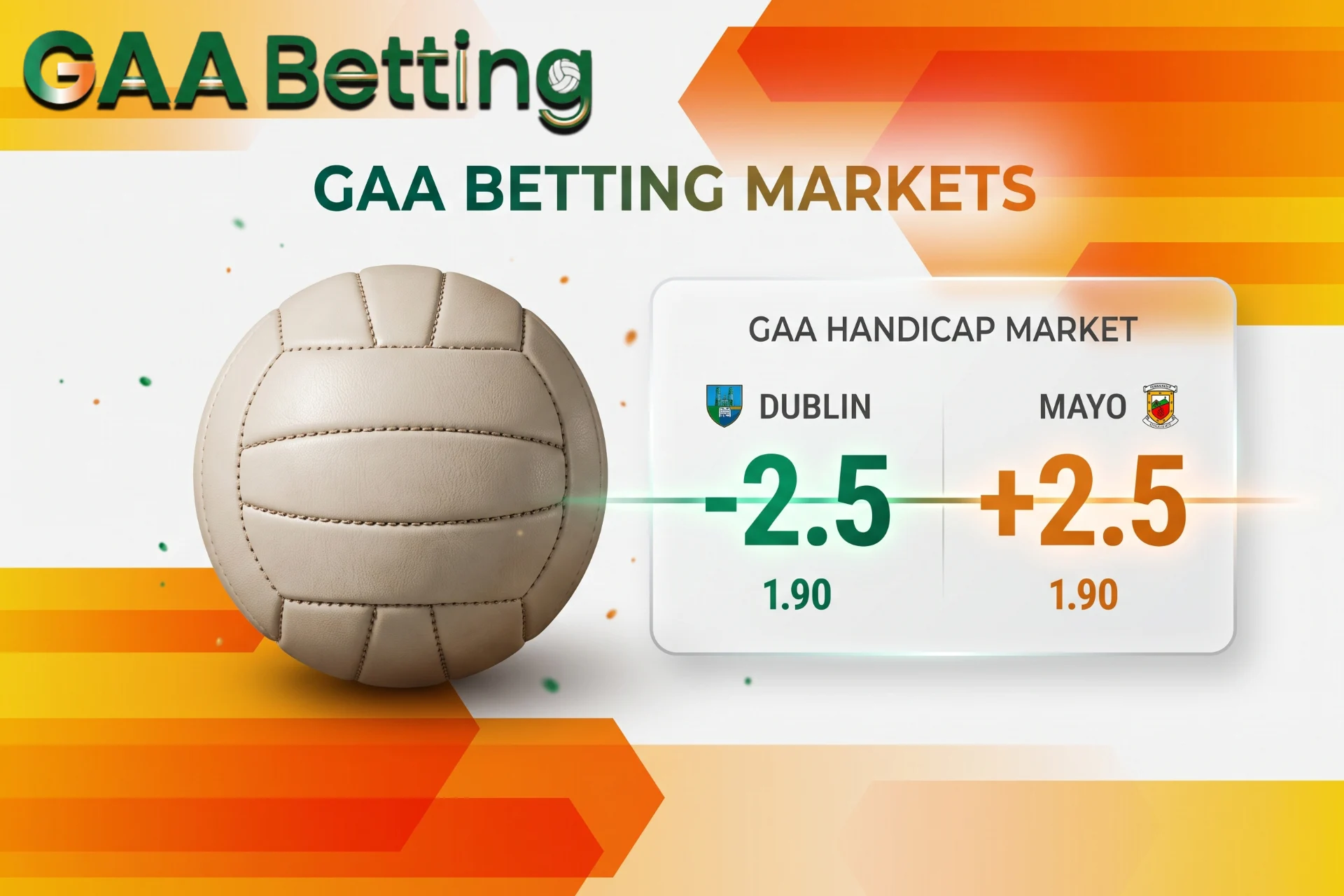
The handicap, or points start, is the workhorse of GAA betting. A team given +6 starts the game six points ahead for settlement purposes. Because scoring in Gaelic football typically lands somewhere in the 25–40 point range per team and hurling considerably higher, handicap lines move in larger increments than in soccer. Watch for the difference between a whole-number line (which can end in a dead heat and a returned stake) and a half-point line such as -6.5, where there is no push. Half-point moves matter: a shift from -5.5 to -7.5 is a meaningful change in the market's view, not a rounding error.
Total points and score-based markets
Totals markets reward anyone who genuinely tracks scoring trends. Two defensively organised football teams in a wet November league game in Division 2 are a very different proposition from a July shoot-out in Croke Park. Rule changes affecting the two-point arc, the throw-in and the kick-out have all altered scoring profiles in recent seasons, and compilers do not always adjust as quickly as the data suggests they should. Keep your own simple tracker of points scored and conceded by each county, split by venue and by grade of opposition, and you will frequently disagree with the posted line.
Player markets and novelty lines
Player markets — first scorer, anytime goalscorer, a named forward to score three or more points, or match top scorer — are popular and heavily margined. They demand specific information: who takes the frees, who takes the 45s, whether the team's main free-taker is fit, and whether a manager is likely to rotate. A player nailed on for eight frees a game is a completely different bet from a corner-forward living on scraps of possession. Also common are "race to 5 points", half-time/full-time doubles, winning margin bands, both teams to score a goal, and bet builders that combine several of the above on a single ticket. The more legs you add, the more margin you are absorbing, so treat multi-leg tickets as entertainment rather than as a serious attack on the market.
What Moves GAA Betting Odds Through the Week
Gaelic games markets are unusually reactive because so much genuine information arrives late. Understanding the weekly rhythm helps you decide whether to take a price early or wait.
Team news, real and otherwise
County teams are traditionally named a couple of days before a game, and the naming of "dummy teams" — line-ups that bear little resemblance to the eventual fifteen — is an accepted part of the culture. That means a price that drifts on Friday evening after a squad announcement can snap back on Sunday morning when local reporters confirm who is actually warming up. Follow credible county correspondents and the Gaelic games pages of the Irish national and local newspaper titles rather than reacting to unverified social posts.
Weather and venue
Few sports are as weather-sensitive. A strong crosswind at a wide, exposed venue suppresses long-range shooting and pushes totals down; a dry, firm surface in midsummer lifts them. Home advantage in provincial football is real but inconsistent, and a neutral venue changes the calculation again. Check the forecast in the final twenty-four hours, not on Wednesday.
Suspensions, appeals and the fixture pile-up
Disciplinary processes can run right up to match day, and a successful appeal restoring a key defender will shorten a price within minutes. Equally, a county facing three games in three weekends may rest players in the dead rubber of a group, something the model rarely knows but local observers often suspect. The same applies at club level, where a side playing a county semi-final six days after a quarter-final will not field the same intensity.
Money
Finally, plain weight of cash. Popular counties with large diasporas — Dublin, Kerry, Cork, Mayo, Galway — attract loyalty money that can shade their prices below fair value, while less fashionable sides drift. If you are unsentimental, that bias is a structural source of value, and it is one of the reasons why shopping around for GAA betting odds on an underdog often yields a bigger relative improvement than shopping for the favourite.
Comparing Operators on GAA Betting Odds, Features and Coverage
All the operators listed below hold the appropriate Irish remote betting licence and are familiar names on the Gaelic games coupon. They differ in market depth, in how early they price up club and league fixtures, and in the tools they wrap around the numbers. The comparison is descriptive rather than a ranking — the right book for you depends on whether you bet outrights, match lines or player props.
| Operator | Typical GAA market depth | Notable features for Gaelic games | Best suited to |
|---|---|---|---|
| Paddy Power | Very broad on championship weekends, including novelty and player lines | Heavy price-boost activity around marquee ties; strong ante-post outright presence | Punters who want boosted headline prices and plenty of prop markets |
| BoyleSports | Deep Irish focus, including league divisions and county club championships | Prices up lower-profile Gaelic fixtures early; consistent handicap and totals coverage | Followers of club and Allianz League action outside the marquee games |
| bet365 | Strong on main markets with extensive in-play lines | Live in-play pricing, bet builder, cash out and detailed match statistics | In-play bettors and anyone building multi-leg tickets |
| Ladbrokes | Solid championship and league coverage with regular offers | Clean digital app navigation, acca-style promotions, request-a-bet options | Casual weekend punters who value a simple interface |
| William Hill | Reliable on inter-county fixtures, lighter on club grades | Long-standing outright books, early ante-post prices after each final | Ante-post players taking a long-term view on championships |
Line shopping in practice
Holding accounts with two or three of these books, rather than one, is the single most reliable way to improve returns over a season. On a 7/2 outright, finding 4/1 elsewhere is a 14% uplift on the same opinion. Over a championship summer, that compounds. A handful of comparison sites and odds-tracker tools cover the Irish market and will surface the best available number on major fixtures, though they are patchier on club games — which is exactly where manual checking pays.
Beyond the Gaelic coupon
Worth remembering that the same apps carrying your hurling handicaps also run racecards for everything from a midweek Irish meeting to Royal Ascot, plus greyhounds and the bloodstock-driven ante-post racing books that come with them, and they often cross-promote between all of it on a busy raceday. That breadth is convenient, but it also means Gaelic games can sit lower in the trading priority list than a Saturday racing card. Traders face a queue of sports every weekend, so errors in GAA betting odds on a Division 4 football tie survive far longer than they would on a big race, and that is an opportunity for the specialist.
League Season: Allianz Divisions, NHL Pricing and In-Play
The Allianz Leagues run from late January into spring, and for serious followers of GAA betting odds they are the most fertile part of the calendar. Motivation is uneven, squads are experimental, weather is hostile and compilers are working with less data than they will have in July. The result is prices that move dramatically and frequently overshoot.
Division dynamics in football
Promotion and relegation shape everything. A county already safe in mid-table Division 2 with a championship opener four weeks away will approach a final-round fixture very differently from a side fighting the drop. Before you back anyone in March, work out what the result is actually worth to each team. The promotion, relegation and division-winner markets themselves are often better value than individual match lines, because they reward you for reading the table rather than the team sheet.
Hurling and the NHL
In hurling, the NHL group structure throws up genuinely awkward pricing. Scoring rates in the national hurling league can be enormous when conditions allow, and totals lines sometimes lag behind that reality by several points. Watch too for counties treating the league as a straight fitness block, fielding heavily rotated sides against opposition who are poised to make a genuine promotion push. Those mismatches in intent are rarely priced accurately.
Live betting and following the action
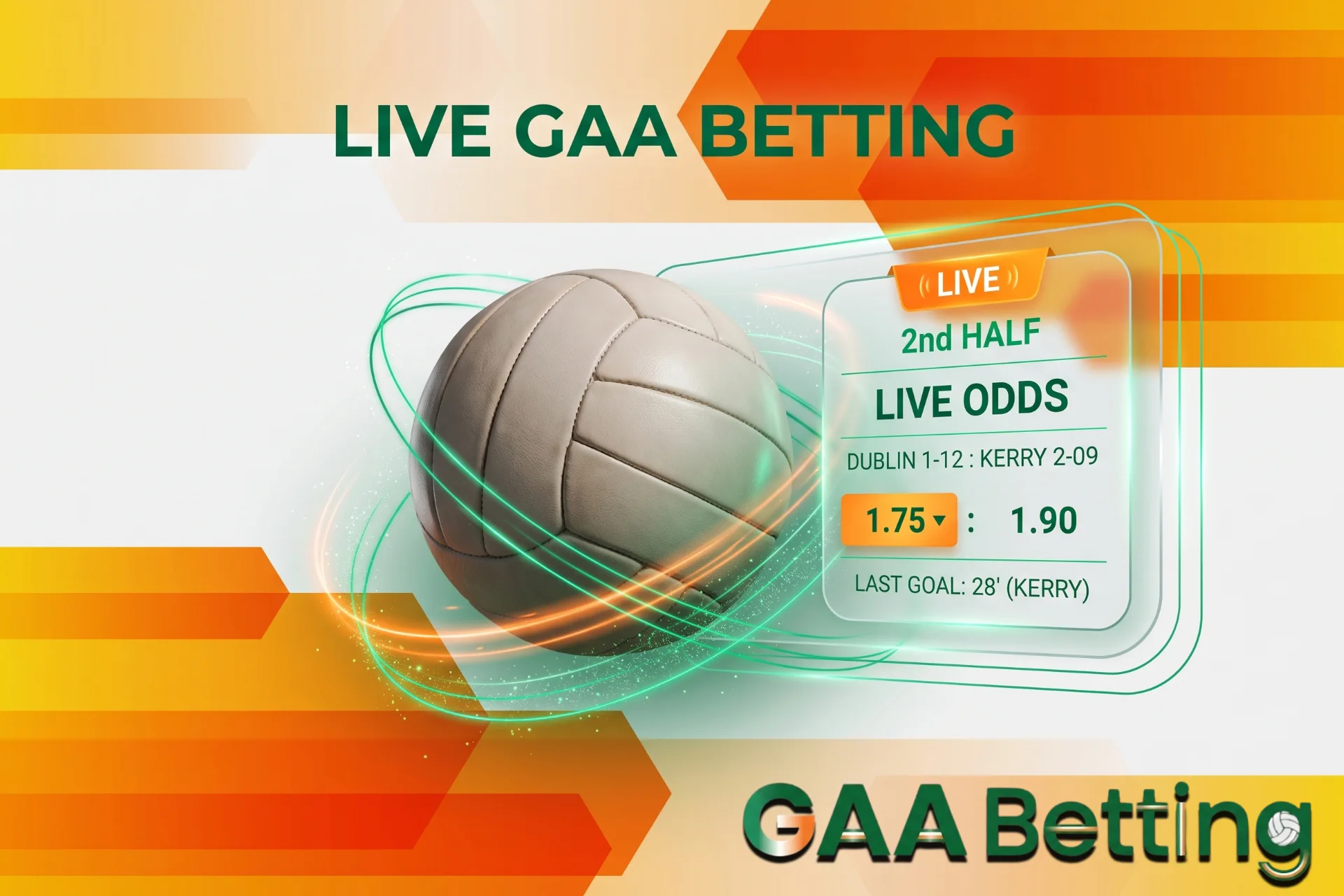
In-play markets on Gaelic games have improved sharply, with suspended-and-repriced handicaps, next-score markets and updated totals available through the major apps. The caveat is latency: if you are watching a streaming feed on GAA+ or a broadcast delayed by even a few seconds, you are trading behind the market. Anyone betting in-play seriously should assume the operator's data feed is faster than their television. Live score trackers and in-app statistics panels help, but they are no substitute for being realistic about your information disadvantage.
Pools and alternative formats
Alongside fixed-odds markets, pools-style products and club-run prediction competitions remain a popular part of Gaelic games culture, where your stake goes into a shared fund rather than against a bookmaker's price. They are a different animal from fixed-odds betting: the payout depends on how many others picked the same outcome, so unpopular selections can pay far more than their true probability would suggest.
Bankroll Discipline, Licensing and Irish Gambling Rules
Nothing in the previous sections matters if the staking is careless. The bettors who last are the ones who treat this as a long series of small decisions rather than a few big ones.
Practical staking
Set a total figure for the season that you are entirely comfortable losing, divide it into units, and keep each bet to one or two units regardless of how strong the opinion feels. Record every bet — fixture, market, price taken, stake and result — in a simple spreadsheet. After a summer you will know whether your edge is in outrights, handicaps or player markets, and you can cut whatever is losing. Most people discover their accumulators are the problem and their patient ante-post bets are the strength.
Value versus winners
A winning bet is not automatically a good bet, and a losing bet is not automatically a bad one. Judge yourself on whether the price you took beat the closing price. If you consistently take 5/2 about teams that start at 2/1, you are finding value even when results are unkind over a short run of games. That discipline is the whole game.
The regulatory picture in Ireland
Only bet with operators that hold a valid Irish licence and are registered for remote betting duty. Ireland's regulatory framework has changed substantially since the Gambling Regulation Act, with the Gambling Regulatory Authority of Ireland (GRAI) taking on licensing, advertising standards, a national self-exclusion register and restrictions on inducements. In practice that means fewer unsolicited free-bet offers, tighter advertising windows, and clearer obligations on operators to intervene where play looks harmful. Those are consumer protections, so use them: deposit limits, time-outs and self-exclusion are built into every licensed app.
Warning signs
Chasing losses on Sunday evening, betting on a club game you know nothing about simply to have an interest, hiding stakes from family, or borrowing to bet are all signals to stop. Support is available in Ireland through Gamblers Anonymous Ireland, the HSE and the free confidential Problem Gambling helpline. Betting on Gaelic games should add to a Sunday afternoon, never define it. If the numbers stop being interesting and start being necessary, the answer is not a better read on GAA betting odds — it is a break.
Tips, opinions and who to trust
Tips are everywhere: newspaper columns, county forums, podcasts and social accounts. The good ones show their reasoning and publish their losers. Treat any source that only advertises winners as entertainment. Use other people's analysis to challenge your own view, then price the bet yourself — because ultimately your profit comes from the gap between your estimate and the bookmaker's, and nobody can calculate that gap for you.
FAQ — Your Questions Answered
Outright markets on the All-Ireland football and hurling championships usually appear within hours of the previous season's finals, sometimes the same evening. Provincial championship prices follow shortly after, while individual match markets typically go up once the fixture schedule is confirmed — often several weeks ahead for inter-county games, and a week or less for county club championship ties. Ante-post prices in autumn and winter tend to be the loosest of the year, because they are set long before anyone knows about winter injuries, retirements, managerial changes or how a squad has trained through the league.
Because Gaelic games are a comparatively low-volume market, each operator's price reflects its own model plus the particular pattern of money its customers have placed. One book may have taken a large bet on a Leinster county and shortened accordingly; another may still be showing its opening line. Differences of half a point on a handicap or a full point of fractional odds on an outright are common, and they are wider on club fixtures and lower league divisions than on a televised All-Ireland semi-final. That is why holding more than one account and comparing before you bet is worthwhile.
It can be, in the right circumstances. Level results are more frequent in Gaelic football than many punters assume, particularly in tight league fixtures between similarly rated counties, in poor conditions that suppress scoring, and in group-stage championship games where extra time is not played. Prices in the 8/1 to 14/1 range are typical. The realistic approach is to treat the draw as an occasional specialist bet in closely matched games rather than a staple, and to consider draw no bet on a favourite when you expect a low-scoring, scrappy contest.
A handicap gives one team a notional head start in points to level the contest for betting purposes. If a county is priced at -7, it must win by eight or more for your bet to succeed; its opponent at +7 succeeds if it wins, draws, or loses by six or fewer. Whole-number lines can produce a dead heat — a loss by exactly seven in that example — which usually means your stake is returned, whereas a half-point line such as -7.5 removes that possibility. Handicaps are useful when you are confident about which team will win but the outright price is too short to be interesting.
Often yes, for informed bettors. League fixtures across the football divisions and the NHL are priced with less data, more rotation and far less public money than summer championship games, so errors persist longer. The trade-off is uncertainty: you need to judge each county's motivation, whether promotion or survival is genuinely at stake, and how heavily a manager is likely to experiment. If you follow a particular division closely and read the table well, the spring campaign can be the most profitable stretch of the year.
Use operators licensed to accept bets from Irish customers and regulated under the framework overseen by the Gambling Regulatory Authority of Ireland. Before you place a bet, set a deposit limit in the app, decide your staking unit in advance, and keep a record of every wager. Never bet money earmarked for essentials, avoid chasing a losing weekend, and make use of the cooling-off and self-exclusion tools that licensed sites are required to provide. If gambling is causing stress for you or someone close to you, confidential support is available in Ireland through the HSE, the Problem Gambling helpline and Gamblers Anonymous Ireland. Anyone under 18 must not bet.
Over a single weekend the gain looks trivial, but across a season it compounds. Taking 11/10 instead of evens on forty selections adds several percent to your turnover return without altering a single opinion. Holding three or four accounts and checking each before you commit is the cheapest edge available to a recreational punter.